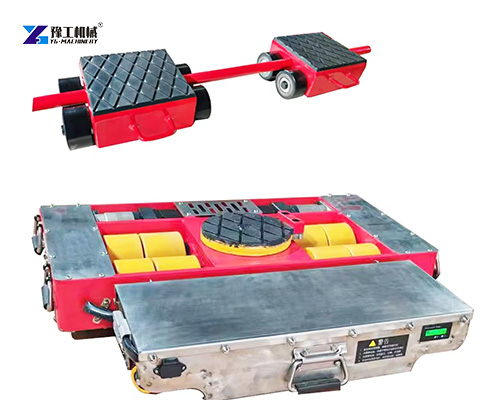
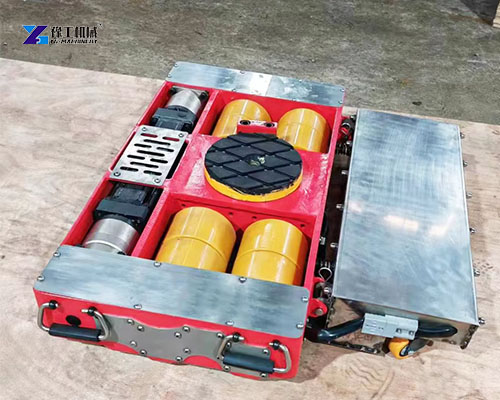
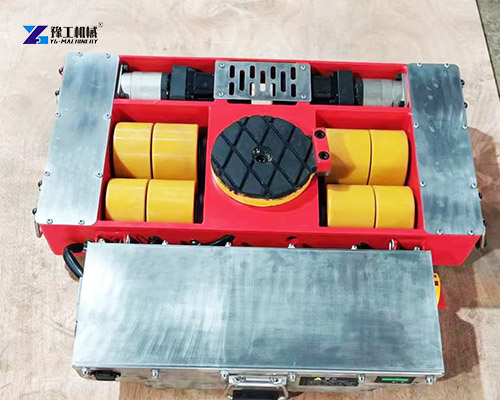
Material transfer carts are powered industrial vehicles used to move heavy materials, equipment, molds, steel products, and assemblies across factories and warehouses. They are commonly used for horizontal transport where forklifts are limited by load size or cranes are inefficient for repeated movement. With high load capacity, low platform height, stable travel, and flexible designs, these carts can improve material handling efficiency. If you need a reliable solution for heavy-load transport, contact YG for a customized transfer cart.
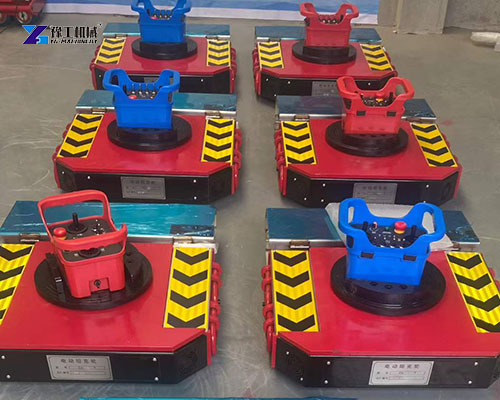
YG Electric Transfer Cart Specifications
The following table provides a quick reference for common YG configurations.
| Model | YG-10 | YG-20 | YG-30 | YG-40 | YG-50 | YG-60 |
| Dimension(mm) | 500*550*145 | 670*620*165 | 740*640*185 | 810*800*182 | 810*800*182 | 1110*880*185 |
| Motor(2 sets with brake) | 500w | 750w | 1000w | 1 500w | 2000w | 3 000w |
| Controller | Dual driver D2T80A | Dual driver D2T80A | Dual driver D2T100A | Dual driver D2T200A | Dual driver D2T200A | Dual driver D2T200A |
| Battery | 48V 30AH (ternary lithium ) | 48V 60AH (ternary lithium or lithium iron phosphate) | 48V 60AH (ternary lithium or lithium iron phosphate) | 48V 120AH (ternary lithium or lithium iron phosphate) | 48V 120AH (ternary lithium or lithium iron phosphate) | 48V 100AH (ternary lithium ) |
| working current | 25A | 60A | 60A | 150A | 150A | 150A |
| Maximum towing weight | 10t | 20t | 30t | 40t | 50t | 60t |
| Plate | 10 mm Q355 steel | 10 mm Q355 steel | 12 mm Q355 steel | 16 mm Q355 steel | 16 mm Q355 steel | 16 mm Q355 steel |
| Drive wheel | 4 | 4 | 4 | 4 | 4 | 8 |
Material Transfer Carts: What Are They Used For?
A material transfer cart is a powered platform vehicle designed to carry heavy loads from one working area to another.
Instead of lifting the load like a forklift or crane, the cart moves it horizontally at floor level. This makes it suitable for repetitive transportation inside industrial facilities.
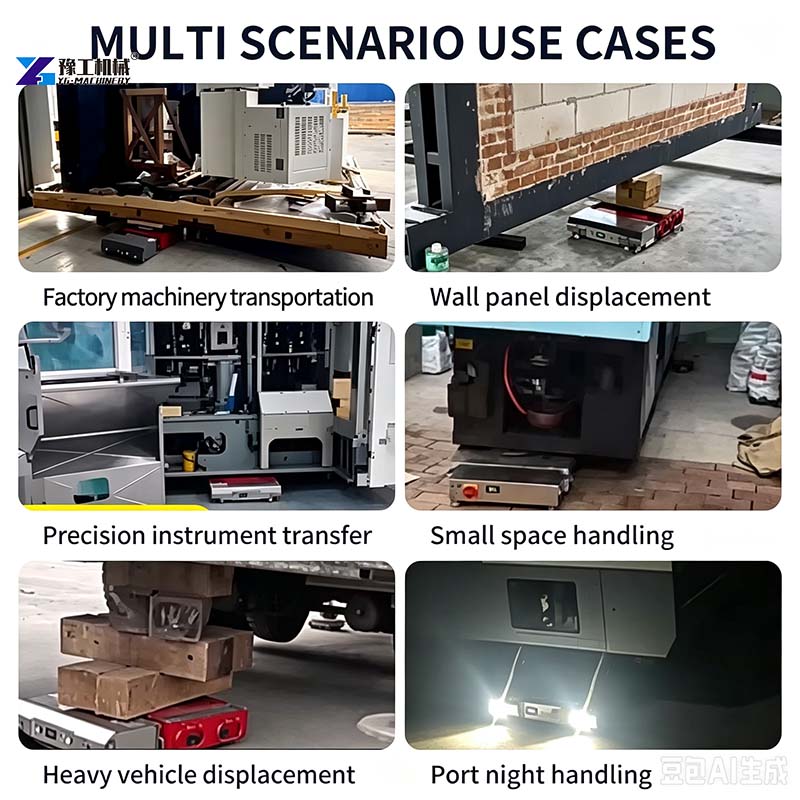
Common applications include:
• Steel coils and plates
• Heavy machinery
• Molds and dies
• Shipbuilding components
• Industrial tanks
• Steel structures
• Production line assemblies
For example, a factory may need to move a 20-ton machine 50 meters between two workshops. A transfer cart can handle this repeated movement without using a crane for every trip.
The main advantages are high capacity, stable operation, low platform height, and customizable dimensions.
Electric Transfer Cart Options for Different Factory Layouts
The factory layout should be considered before choosing an electric transfer cart.
Different power and drive configurations suit different working conditions.
| Type | Suitable Application | Main Point |
| Rail powered | Fixed routes | Requires rails |
| Battery powered | Flexible routes | Requires charging |
| Cable powered | Frequent operation | Cable management |
| Trackless | Changing routes | Requires suitable floor |
Rail-powered carts are suitable when the same route is used every day. They provide accurate guidance and are widely used for heavy loads.
Battery-powered carts offer more flexibility. They can work where installing rails is difficult or where the transportation route changes.
Trackless models are useful for factories with several workstations. However, the floor must be strong, flat, and suitable for the expected wheel load.
The basic rule is simple: choose the cart according to the route and working environment, not capacity alone.
Motorized Transfer Cart Capacity: How Much Do You Need?
Capacity is one of the first specifications buyers consider. But a motorized transfer cart should not be selected simply by matching the cart rating to the current load.
Suppose your heaviest equipment weighs 18 tons. An 18-ton cart may not be the best choice if you expect heavier loads in the future.
Consider these factors:
• Maximum load
• Load distribution
• Load dimensions
• Operating frequency
• Starting and stopping conditions
• Future production needs
Load distribution is especially important.
A 20-ton load concentrated in the center creates different wheel loads from a 20-ton load spread across a long platform. This can affect the frame, wheels, axles, and drive system.
YG can evaluate these conditions and recommend a suitable capacity instead of simply selecting a standard model.
Material Transfer Carts: Rail or Trackless?
Choosing between rail and trackless designs is an important purchasing decision.
A rail transfer cart follows a fixed route. It is suitable for repetitive transportation between production areas.
A trackless transfer cart can move without fixed rails and offers greater flexibility for changing routes.
| Requirement | Better Option |
| Fixed route | Rail cart |
| Repetitive transport | Rail cart |
| Existing rails | Rail cart |
| Changing routes | Trackless cart |
| Multiple workstations | Trackless cart |
| Difficult rail installation | Trackless cart |
For example, a steel factory with a fixed 80-meter route may benefit from a rail system. A machinery manufacturer that frequently changes its workshop layout may prefer a battery-powered trackless model.
Neither type is universally better. The right choice depends on route, floor condition, load, frequency, and future layout changes.
Electric Transfer Cart Specifications Buyers Should Check
When requesting a quotation, avoid sending only “20-ton electric transfer cart.”
A manufacturer needs more information to select the right configuration.
Important specifications include:
• Rated capacity
• Platform length and width
• Load dimensions
• Travel distance
• Travel speed
• Rail gauge
• Power supply
• Control method
• Operating frequency
• Floor or rail condition
• Working environment
Travel speed is also important. Many industrial applications use around 10–25 m/min, depending on the load and site conditions.
Higher speed is not always better. The cart must start and stop smoothly while carrying the actual load.
Outdoor use, high temperatures, dust, moisture, or corrosive environments may also require additional protection.
Providing complete information at the quotation stage helps reduce design changes and communication time.
How to Choose a Motorized Transfer Cart
Before ordering, answer these questions:
What is the maximum load?
Use the heaviest expected load rather than the average load.
What are the load dimensions?
The platform should provide enough support without being unnecessarily oversized.
How far does it travel?
Travel distance affects the power and control system.
Is the route fixed?
Fixed routes often suit rail carts. Flexible routes may suit trackless carts.
How often will it operate?
A cart running 30 cycles per day may need a different configuration from one used only a few times per week.
What power is available?
Confirm the factory power supply before selecting the electrical system.
What is the floor condition?
Trackless carts depend heavily on floor strength and flatness.
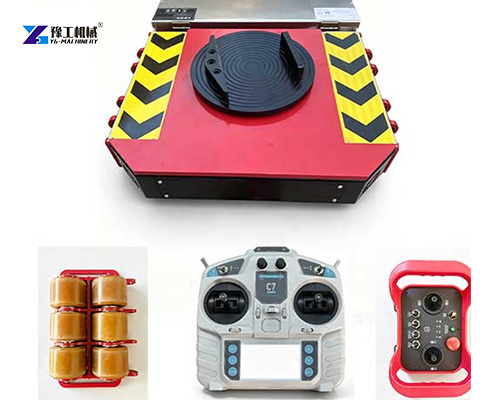
Do you need remote control?
Remote control can make operation easier and improve operator visibility.
Will you need automation later?
Tell the manufacturer early if future automatic operation is possible.
Material Transfer Carts for Different Industries
Transfer carts are used across many heavy industries.
Steel plants: Move coils, plates, structures, and other heavy steel products.
Machinery manufacturing: Transport machines, molds, dies, and workpieces between production stations.
Shipbuilding: Move large assemblies and components across workshops.
Warehouses: Connect storage areas with production lines.
The platform can also be customized according to the load.
A flat deck is suitable for general equipment. A V-shaped support can help secure cylindrical loads. Other options can include rollers, lifting platforms, or special fixtures.
This means the cart should be designed around the load and application.
A Simple Transfer Cart Selection Example
Consider a machinery factory with the following requirements:
| Requirement | Example |
|---|---|
| Maximum load | 20 tons |
| Load size | 5 × 2.5 m |
| Travel distance | 60 m |
| Daily operation | 30–40 cycles |
| Route | Fixed |
| Location | Indoor |
Because the route is fixed and the cart will operate frequently, a rail transfer cart may be a practical option.
The manufacturer should then confirm the rail gauge, wheel load, motor power, platform dimensions, speed, and power supply.
If the factory expects loads of 25 tons in the future, this should be considered before production.
Good planning can prevent expensive modifications later.
What to Ask a Material Transfer Cart Manufacturer
Before placing an order, ask the supplier to confirm:
• Final technical drawing
• Rated capacity
• Platform dimensions
• Power supply
• Rail specifications
• Control system
• Safety devices
• Delivery scope
• Installation requirements
• Spare parts
• Warranty and after-sales service
For overseas buyers, technical drawings are especially useful. They help confirm whether the cart will fit the workshop, rails, doors, and surrounding equipment.
YG can review your load information and operating conditions and develop a suitable configuration before manufacturing.
FAQs About Material Transfer Carts
What is a material transfer cart used for?
It is used to move heavy materials, equipment, components, and assemblies horizontally inside industrial facilities.
What is the difference between an electric transfer cart and a motorized transfer cart?
Both terms generally describe powered industrial carts. “Electric transfer cart” focuses more on the electrical drive system, while “motorized transfer cart” is a broader term for a cart driven by a motor.
How do I choose the right capacity?
Start with the maximum load. Then consider load distribution, platform size, operating frequency, and future requirements.
Are rail carts better than trackless carts?
Not always. Rail carts are usually suitable for fixed routes, while trackless carts provide greater flexibility. The correct choice depends on the factory layout.
What information is needed for a quotation?
Provide the load capacity, load size, platform dimensions, travel distance, route type, speed, power supply, operating frequency, and floor or rail conditions. Photos or drawings are also helpful.