
Concrete floor flatness, construction efficiency, and labor cost control determine the overall quality and profitability of industrial and commercial concrete projects. For decades, contractors have relied on traditional concrete screeding methods to finish fresh concrete slabs. However, with the rising demand for high-precision warehouse floors, factory slabs, and large-area concrete pouring, laser screed machines have gradually become the mainstream solution in modern construction.
Many new contractors and project owners are confused: Is a laser screed worth replacing traditional screeding equipment? What are the core differences in accuracy, speed, labor cost, and application scenarios?
In this guide, we will make a detailed comparison between laser screed machines and traditional screed tools, helping you select the most suitable concrete leveling solution for your project.
Request Concrete Laser Screed Machine Pricing
What Is a Laser Screed Machine?
A laser screed machine is a modern integrated concrete floor leveling device designed for high-precision and large-area concrete construction. YG laser screeds integrate concrete spreading, high-frequency vibration, and precise leveling into one single process, fully solving the defects of scattered and cumbersome traditional construction processes.
Equipped with an intelligent laser control system, the laser screed can maintain consistent elevation throughout the construction process, automatically correcting height deviations in real time. It effectively improves concrete compactness and floor flatness, fully meeting the strict FF/FL flatness standards required for modern warehouses, industrial workshops, and large commercial buildings.
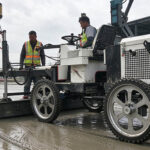
YG provides three mainstream models: walk-behind laser screed for narrow and small sites, ride-on laser screed for large-area mass pouring, and telescopic boom laser screed for super-wide and obstacle-intensive construction areas.
Request Concrete Laser Screed Machine Pricing

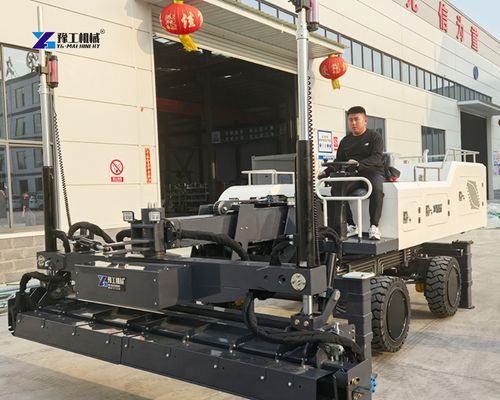

YG Concrete Laser Screed Machine Specifications-OEM Support
| Model | YGJX31 | YGJX32 | YGJX33 | YGJX34 |
| Engine | ||||
| Model | Generator set | GX390 Electric start | GX390 Electric start | GX390 Electric start |
| Power | 2.0kW | 13hp/3600rpm | 13hp/3600rpm | 13hp/3600rpm |
| Fuel tank (L) | 14.5 | 6.5 | 6.5 | 6.5 |
| Running device | ||||
| Drive | Motor | Hydraulic motor | Hydraulic motor | Hydraulic motor |
| Running mode | Infinitely variable speed | Handle control, stepless speed | Handle control, stepless speed | Handle control, stepless speed |
| Running speed(m/min) | 0-36 | 0-45 | 0-65 | 0-45 |
| Suggest working speed(m/min) | 5 | 5 | 5 | 5 |
| Screed head | ||||
| Type | Self-leveling | Electric control, self-leveling | Self-leveling | Hydraulic control, self-leveling |
| Width | 2500mm | 2500mm | 2500mm | 2500mm |
| Exciting force | 500N | 500N | 500N | 500N |
| Vibration frequency | 50Hz | 50Hz | 50Hz | 50Hz |
| Laser control system | ||||
| Control type | Microcomputer laser scan | Microcomputer laser scan | Microcomputer laser scan | Microcomputer control |
| Operation mode | Walk-behind | Walk-behind | Walk-behind | Walk-behind |
| Forward and reverse | Handgrip control, stepless speed-walking | Hydraulic control | Handgrip control, stepless speed-walking | Hydraulic control |
| Size and weight | ||||
| Working size(mm) | 2758*2622*1980 | 2740×2659×1980 | 2578×2643×1980 | 2780*2622*1980 |
| Weight(kg) | 295 | 365 | 380 | 410 |
Request Concrete Laser Screed Machine Pricing
What Is Traditional Screeding (Truss & Manual Screed)?
Traditional concrete screeding mainly includes manual screeding and truss screed leveling, which are the conventional construction methods adopted by the construction industry for a long time.
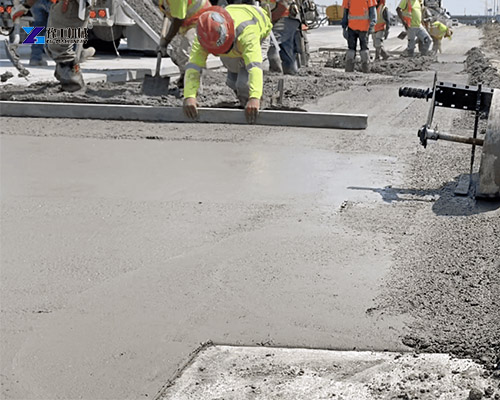
Manual screeding relies entirely on workers to scrape and level fresh concrete with screed rulers. The construction effect depends entirely on the operator’s experience, resulting in unstable flatness, large human errors, and low construction efficiency. It requires multiple workers to cooperate in spreading, vibrating, and leveling separately.
The truss screed is a mechanical upgrade of manual construction. It uses a truss structure to walk on the formwork for integral leveling. Although it improves construction speed to a certain extent, it still has obvious limitations: it can only level along fixed formwork tracks, cannot adjust elevation intelligently, and is prone to cumulative errors, resulting in uneven floor flatness.
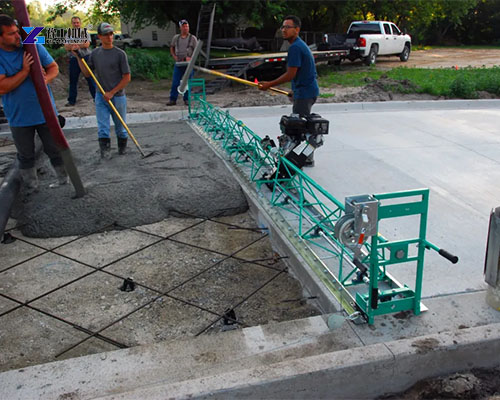
Laser Screed vs Traditional Screed: Detailed Comparison Table
| Comparison Item | Laser Screed Machine | Traditional Truss/Manual Screed |
| Construction Accuracy | High precision, stable FF/FL floor flatness, real-time laser calibration, almost no height deviation | Low accuracy, serious human error, prone to uneven floors, difficult to meet high-standard industrial floor requirements |
| Working Efficiency | One-person operation, integrated spreading, vibration and leveling, large daily pouring area, suitable for mass construction | Multiple workers required, separate processes, slow progress, low daily output, easy to delay construction period |
| Labor Cost | Greatly save labor, reduce manual dependence, lower long-term construction costs | High labor demand, high labor costs, increased overall project investment |
| Construction Scope | Flexible operation, no fixed track limitation, adaptable to large areas, narrow spaces, and complex site conditions | Restricted by formwork and site conditions, poor flexibility, unable to adapt to complex construction scenarios |
| Finished Floor Quality | Uniform concrete compactness, flat and dense floor surface, few later repairs, high overall floor durability | Uneven compactness, easy hollowing and cracking, high repair rate, poor overall floor consistency |
| Applicable Projects | Warehouses, industrial workshops, large shopping malls, super-large concrete slabs, high-standard industrial floors | Small ordinary concrete floors, temporary pavement, low-flatness requirement projects |
Request Concrete Laser Screed Machine Pricing
5 Advantages of Laser Screed Over Traditional Screeding
1. Unmatched Construction Precision
The laser control system of the laser screed achieves millimeter-level precise leveling. Different from traditional construction relying on manual visual inspection and fixed tracks, it can automatically monitor and adjust the construction elevation in real time, ensuring the entire concrete slab maintains consistent flatness. This is crucial for modern automated warehouses and heavy-duty industrial floors that require high flatness standards.
2. Dramatically Improve Construction Efficiency
Traditional screeding requires division of labor: spreading concrete by workers, vibrating with vibrating rods, and leveling with screed tools, with disjointed processes and slow progress. YG laser screed completes all procedures in one pass, greatly shortening the concrete pouring cycle. For large-area warehouse projects, the construction efficiency can be increased by more than 3 times compared with traditional methods.
3. Effectively Control Project Costs
Although the initial investment of a laser screed is higher than traditional tools, it can greatly reduce labor input and avoid rework losses caused by unqualified floor flatness. In the long run, it significantly reduces the comprehensive construction cost of the project and improves the profit margin of contractors.
4. Strong Site Adaptability
YG’s complete laser screed product line covers small walk-behind models for narrow sites, ride-on models for large-area construction, and telescopic boom models for special working conditions. It can cope with various complex construction sites, while traditional truss screeds are highly restricted by site space and formwork layout.
Request Concrete Laser Screed Machine Pricing
When Is Traditional Screeding Still Suitable?
Although laser screeds have obvious advantages, traditional screeding tools are still cost-effective in some specific scenarios:
- Small residential concrete floors, temporary roads, and small-area pavement projects
- Projects with low floor flatness requirements and short construction cycles
- Small-scale renovation projects that do not require large mechanical equipment
For formal industrial, commercial, and large-scale infrastructure concrete projects, laser screeds are undoubtedly the optimal choice.
Final Recommendation: Which One Should You Choose?
If you are undertaking warehouse floors, industrial workshops, large supermarket floors, and other high-standard concrete slab projects, a laser screed machine is a must-have equipment to ensure project quality and construction efficiency. It can help you win more high-quality engineering projects and form standardized construction advantages.
If your projects are mostly small civil floors with low precision requirements, traditional manual or truss screeds can meet the basic construction needs.
Request Concrete Laser Screed Machine Pricing
Get Professional Laser Screed Solutions From YG
YG provides full-series concrete laser screed machines, including walk-behind, ride-on, and telescopic boom models, covering all types of concrete floor construction scenarios. We also support complete construction solutions matched with concrete pumps and floor marking machines.
Contact us now to get a customized equipment quotation and professional project construction guidance!