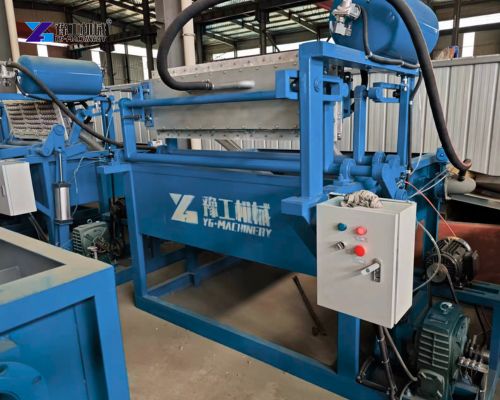


Looking for a semi automatic egg tray machine that balances cost and output? This equipment converts waste paper into molded egg trays through pulping, forming, and drying. It suits small to mid-scale producers who want higher output than manual systems without the capital burden of full automation. If you need a reliable machine for local egg farms or packaging distribution, YG can help you configure the right setup. 【WhatsApp/WeChat/Skype/Phone】+86 159 3715 2330
Get Semi Automatic Egg Tray Machine Price
What Is a Semi Automatic Egg Tray Machine and Who Needs One?
A semi automatic egg tray making machine sits between manual and fully automatic systems. It handles pulping and forming automatically, but tray transfer and stacking often require some manual input.
For producers in emerging markets or small factories, this trade-off makes practical sense. You get consistent tray quality with lower upfront investment and simpler maintenance. The machine runs on widely available waste paper and requires basic utilities.
Here is the key difference:
- Manual machine: High labor, low cost, very limited output
- Semi automatic machine: Moderate labor, reasonable cost, 1500–7000 pcs/h
- Fully automatic machine: Low labor, high cost, high output
If your target is 15,000–50,000 trays per day and labor is affordable in your area, a semi automatic unit often delivers the fastest payback.
Get Semi Automatic Egg Tray Machine Price
YG Semi Automatic Egg Tray Machine Parameters
Below are the standard models we manufacture. Each unit is factory-tested before shipment, and you receive a test report with your machine.
| Model | Capacity/H | Power/hour | Paper Consumption/H | Water Consumption/H |
| YG-1500 – 4X1 | 1500pcs/h | 38kw | 120kg | 240kg |
| YG-2500 – 3X4 | 2500pcs/h | 55kw | 200kg | 400kg |
| YG-3000 – 4X4 | 3000pcs/h | 60kw | 240kg | 480kg |
| YG-4000 – 4X8 | 4000pcs/h | 95kw | 320kg | 640kg |
| YG-5000 -5X8 | 5000pcs/h | 95kw | 400kg | 800kg |
| YG-7000 -6X8 | 7000pcs/h | 120kw | 480kg | 960kg |
Read startup business guidance:How to Start an Egg Tray Manufacturing Business.
Get Semi Automatic Egg Tray Machine Price
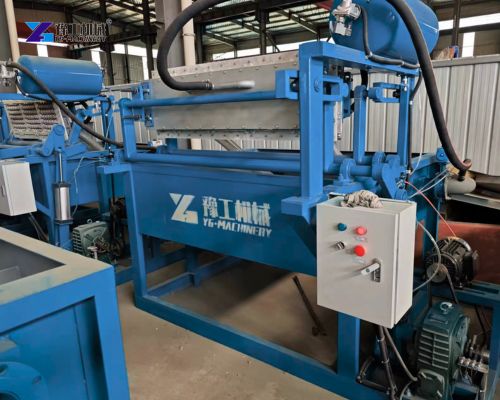
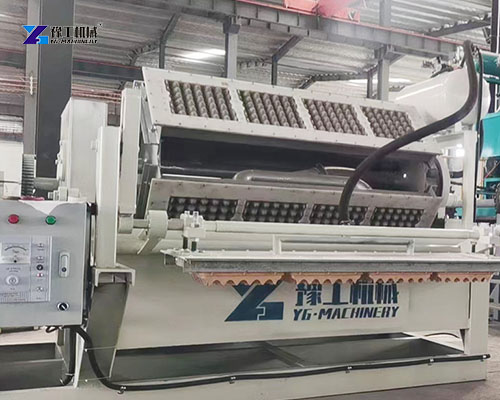
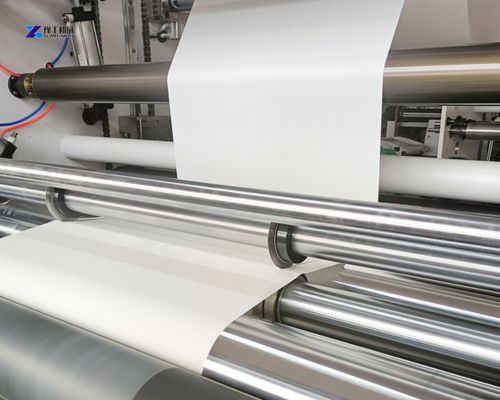
The Real Operating Cost of a Semi Automatic Egg Tray Machine
Raw material cost drives your profit margin. Waste paper typically costs $30–$50 per ton in most markets . One ton of waste paper produces roughly 12,000 standard egg trays.
Let us run the numbers on a YG-4000 (4X8 model) running 8 hours daily:
| Cost Item | Monthly Estimate |
| Waste paper (320 kg/h × 8h × 22 days) | ~$2,200 |
| Electricity + water | ~$1,400 |
| Labor (4–5 workers) | ~$3,000–$4,000 |
| Maintenance + spare parts | ~$400 |
| Total monthly operating cost | ~$7,000–$8,000 |
At a wholesale tray price of $0.10–$0.15 per piece, monthly revenue from 4000 pcs/h output reaches $56,000–$84,000. The margin remains strong even after accounting for drying fuel and transportation .
The key variable is your local tray price. In regions with active poultry farming, trays sell quickly and prices hold firm. In saturated markets, margins compress. Know your market before choosing capacity.
Get Semi Automatic Egg Tray Machine Price
How to Choose the Right Capacity for Your Semi Automatic Egg Tray Making Machine
Oversizing kills profitability. Undersizing limits growth. Here is a practical framework:
Step 1: Calculate your daily demand
If you supply 5 egg farms with 10,000 trays each per week, your weekly need is 50,000 trays. Daily demand (5 working days) = 10,000 trays.
Step 2: Add realistic downtime
Machines need maintenance. Assume 80% uptime. 10,000 trays ÷ 0.8 = 12,500 trays daily capacity.
Step 3: Match to machine output
At 8 hours daily operation, 12,500 ÷ 8 = 1,562 pcs/h. The YG-1500 fits. But if you plan to grow, the YG-2500 gives breathing room without excessive idle cost.
Step 4: Confirm drying capacity matches forming capacity
A common mistake: buying a 4000 pcs/h forming machine but a dryer that only handles 2500 pcs/h. The forming machine becomes the bottleneck‘s opposite—it produces wet trays faster than the dryer can process them .
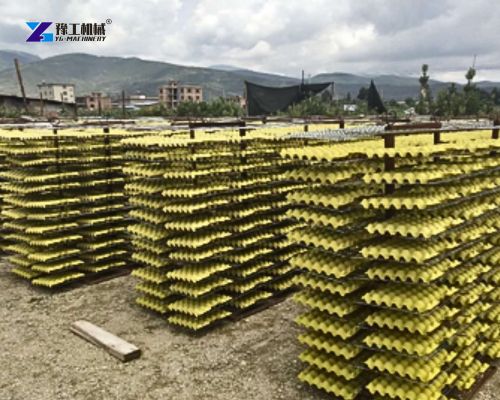
For semi automatic systems, brick kiln drying or multi-layer metal dryers work well. Natural sun drying remains viable in sunny climates but introduces weather risk and larger labor requirements .
Raw Material Quality: What Makes Good Egg Trays
Not all waste paper performs equally. The fiber source affects tray strength, surface finish, and drying time.
Best paper types:
- Old corrugated cardboard (OCC) – strong fibers, excellent tray rigidity
- Kraft paper – good strength, clean appearance
- Office paper / A4 – fine fiber, smooth surface
Acceptable with caution:
- Newspapers – shorter fibers, weaker trays
- Mixed recovered paper – variable quality, test before committing
Avoid:
- Wax-coated paper – blocks fiber bonding
- Plastic contamination – ruins pulp consistency
- Wet or moldy paper – introduces bacteria, causes defects
A practical ratio: 1 part paper to 3–4 parts water in the initial pulping stage . Some producers use up to 1:10 for thinner pulp, but higher water content means more drying energy and longer drying times .
For waterproof trays (needed for cold storage or humid climates), add a waterproofing agent during pulping. This small additive cost extends tray life significantly.
View overseas real‑world project:Pulp Egg Tray Making Machine sold to Australia.
Get Semi Automatic Egg Tray Machine Price
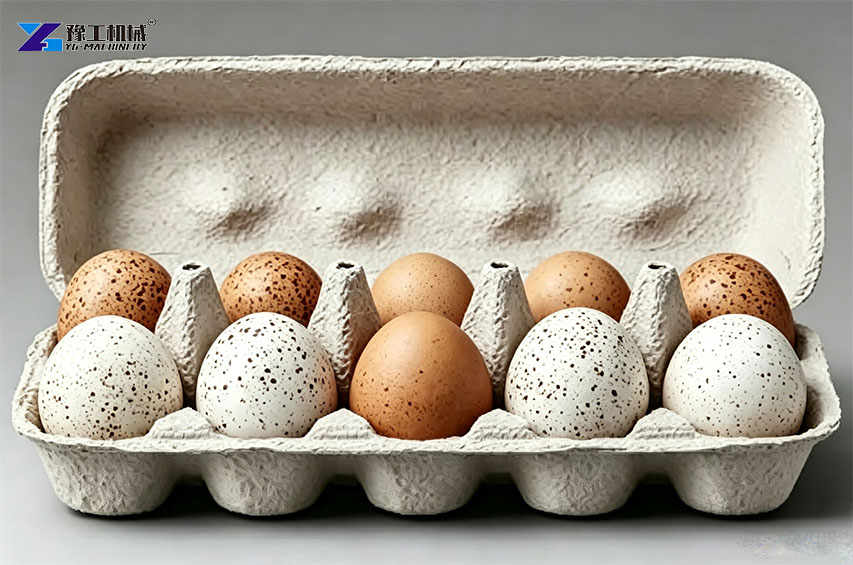
Drying Methods That Work with Semi Automatic Systems
Drying is where semi automatic setups differ most from fully automatic lines. You have three realistic options:
Natural Sun Drying
Lowest equipment cost. Requires 100–200 drying racks and ample outdoor space. Weather-dependent and labor-intensive for loading/unloading. Best for dry, sunny regions with cheap land .
Brick Kiln Drying Room
A step up. Wet trays load onto carts and enter a heated room at 180–200°C for 30 minutes. Works in any weather. Labor remains moderate—workers load and unload carts manually .
Multi-Layer Metal Dryer
The most efficient semi automatic option. Trays travel through a 6-layer heated channel for approximately 25 minutes. Consistent moisture control and minimal weather impact. Higher initial investment but lower labor and better product uniformity .
For a 3000–5000 pcs/h semi automatic line, a brick kiln or multi-layer metal dryer makes operational sense. Sun drying struggles to keep pace with forming output and introduces quality variation.
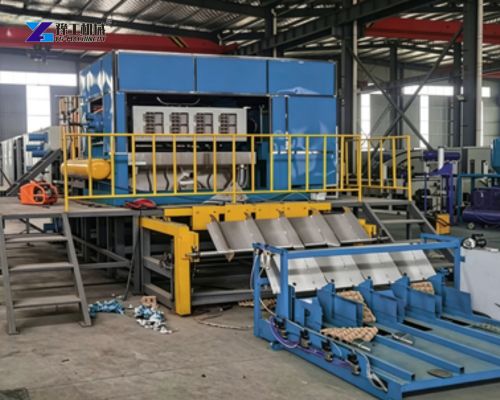
Common Mistakes Buyers Make with Semi Automatic Egg Tray Machines
Mistake 1: Comparing forming machine prices only
The forming unit is one component. You also need pulping equipment, molds, drying system, and transfer mechanisms. A “cheap” forming machine quote often excludes the dryer, making comparison meaningless .
Mistake 2: Ignoring local voltage and frequency
Standard Chinese machines run on 380V/50Hz. Many African and Latin American markets use 220V or 60Hz. Confirm electrical compatibility before shipping. Rewiring after arrival costs time and money.
Mistake 3: Assuming any waste paper works
Test your local paper supply before finalizing the order. Send samples to your supplier for pulping trials. A paper mix that works in one region may produce weak or deformed trays in another.
Mistake 4: Underestimating water consumption
A 4000 pcs/h machine uses 640 kg of water per hour. That is roughly 5,120 kg daily (about 1,350 gallons). Confirm your water supply and drainage can handle continuous operation.
Mistake 5: Skipping the mold specification discussion
The mold determines tray shape, cell count, and compatibility with your target market. Standard 30-cell trays dominate, but some regions prefer 20-cell or 12-cell configurations. Clarify before production begins.
Get Semi Automatic Egg Tray Machine Price
FAQ: Semi Automatic Egg Tray Machine Questions from Buyers
Q1: Can a semi automatic machine run continuously 24/7?
Semi automatic systems are designed for shift-based operation. Running continuously accelerates wear on vacuum pumps, transfer mechanisms, and molds. For 24/7 production, a fully automatic line makes more economic sense. Most semi automatic users run 8–16 hours daily.
Q2: How long does mold replacement take?
Changing molds on a semi automatic machine typically takes 2–4 hours with trained workers. This includes removing old molds, installing new ones, and running alignment checks. Plan production batches to minimize changeover frequency.
Q3: What is the typical delivery time for a YG semi automatic egg tray machine?
Standard models ship within 30–45 days after order confirmation. Custom mold specifications may add 10–15 days. YG provides factory testing video and test report before shipment.
Q4: Do I need special training to operate the machine?
Basic operation can be learned in 2–3 days. YG provides operation manuals and video guides. For complex troubleshooting and maintenance, we offer online technical support. On-site installation supervision is available for larger orders.
Q5: Can the same machine produce egg cartons or fruit trays?
Yes, with the appropriate molds. The pulping and forming systems work with various molded pulp products. Egg cartons (closed lid type) require different mold configurations and may need additional drying time due to thicker walls. Fruit trays follow similar principles.