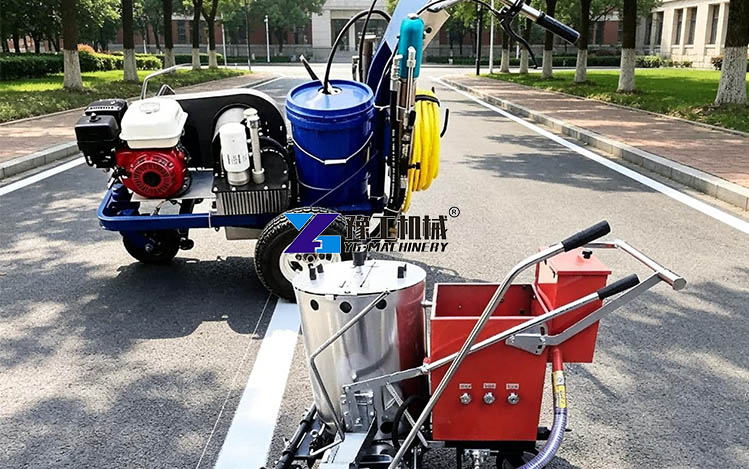
When buying a road marking machine, the lowest machine price is not always the lowest project cost. thermoplastic vs. cold paint marking machines is mainly a choice between long-term durability and flexible, lower-cost application. Thermoplastic machines heat solid marking material before application, while cold paint machines apply liquid paint directly. Your road type, traffic volume, marking area, climate, and repainting schedule should all be considered before choosing equipment. 【WhatsApp/WeChat/Skype/Phone】+86 159 3715 2330
Get Thermoplastic and Cold Paint Marking Machine Price
Thermoplastic Striping Equipment vs. Cold Paint Road Marking Machine
The biggest difference is how the marking material is prepared and applied.
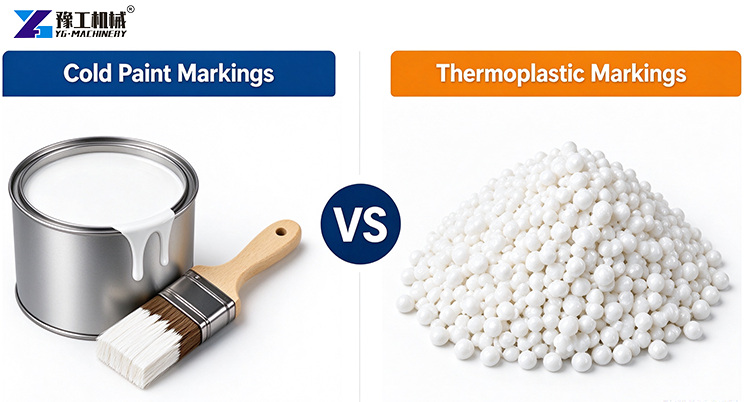
Thermoplastic striping equipment uses solid thermoplastic material. The material is heated until it becomes liquid and is then applied to the pavement. After cooling, it forms a durable marking layer.
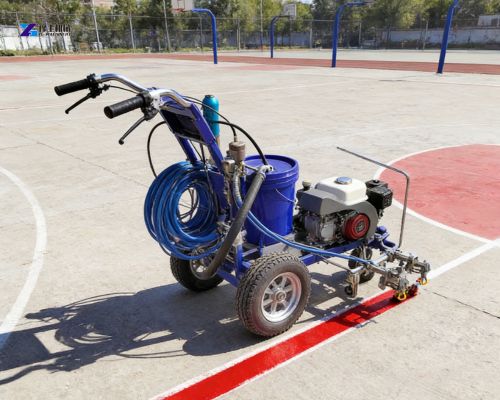
A cold paint road marking machine uses liquid traffic paint without a heating process. Depending on the machine, paint can be sprayed or mechanically applied to create lines, arrows, parking spaces, and other markings.
| Factor | Thermoplastic | Cold Paint |
| Material | Solid thermoplastic | Liquid traffic paint |
| Heating | Required | Not required |
| Initial equipment investment | Generally higher | Generally lower |
| Durability | Generally higher | Generally moderate |
| Material preparation | Heating and temperature control | Mixing and direct application |
| Typical projects | Highways, intersections, heavy traffic | Parking lots, urban roads, maintenance |
For contractors working on large road projects, the difference becomes especially important when repainting requires traffic control or road closures.
Request Get Thermoplastic Striping Machine Price
Advantages and Disadvantages of Thermoplastic Road Marking Machines
The main reason contractors choose thermoplastic is durability.
When correctly formulated and applied, thermoplastic markings can provide strong adhesion, good visibility, and long service life. TxDOT notes that thermoplastic can have typical service lives of around 2–3 years depending on traffic, while properly formulated products may last longer under suitable conditions.
Main advantages
- Longer service life: Suitable for roads where frequent repainting is inconvenient.
- Good visibility: Glass beads can be incorporated or applied during marking to improve retroreflectivity.
- Fast setting: The material cools and becomes usable shortly after application.
- Suitable for heavy traffic: Commonly used for highways, intersections, lane lines, and crosswalks.
- Consistent line quality: A controlled spreading system can maintain uniform line width.
Points to consider
Thermoplastic equipment is more complex because it includes a heating system. Operators also need to control material temperature and pavement conditions.
For example, TxDOT recommends an application temperature around 420°F (about 216°C) for many thermoplastic applications. The pavement should also be clean and dry for proper bonding.
So, thermoplastic is not simply a matter of buying a machine and starting work. Material handling, heating, surface preparation, and operator training all affect the final result.
Request Get Thermoplastic Striping Machine Price

Cold Paint Road Marking Machine Advantages for Flexible Projects
Cold paint equipment has a different advantage: simplicity.
There is no need to melt solid material before marking. This makes cold paint machines practical for contractors who frequently move between smaller projects.
Typical advantages include:
- Lower initial equipment investment
- No thermoplastic heating process
- Easy material replacement
- Flexible color selection
- Convenient for maintenance work
- Suitable for parking lots and urban roads
- Practical for projects where markings are changed frequently
Cold paint is not automatically a poor choice. In some applications, repainting a low-traffic area periodically can be more economical than paying for a more durable material.
The key is to compare the complete operating cost, rather than judging the technology only by the purchase price.
Request Cold Paint Road Marking Machine Price
Thermoplastic vs. Cold Paint Marking Materials
The material itself is another important purchasing factor.
Thermoplastic Material
Thermoplastic marking material commonly contains four major components:
- Binder
- Pigment
- Glass beads
- Filler material
According to TxDOT, fillers can include calcium carbonate, sand, or similar materials. Thermoplastic binders can be hydrocarbon- or alkyd-based.
The material is solid at room temperature. Heating changes it into a liquid that can be applied to the road.
Cold Paint Material
Cold traffic paint is supplied as a liquid. Depending on the product and local regulations, contractors may use water-based, solvent-based, acrylic, or other traffic coating systems.
The advantage is simple: the material is ready for application without a melting kettle or heating tank.
Both systems can use glass beads to improve nighttime visibility, but the exact material formulation should always match the road surface and local specification.
Get Material and Machine Configuration Advice
When to Choose Thermoplastic Striping Equipment
Thermoplastic equipment is worth considering when your projects require durable markings and fewer maintenance cycles.
It is particularly suitable for:
- Highways and expressways
- High-traffic intersections
- Center lines and lane dividers
- Edge lines
- Stop bars and pedestrian crossings
- Long-term municipal road projects
- Projects where repainting causes significant traffic disruption
Surface preparation is important. Thermoplastic bonds particularly well with asphalt through heat fusion, while concrete applications may require a suitable primer because the bonding mechanism is different.
If your contractor regularly handles large road-marking contracts, investing in thermoplastic equipment can also expand the types of projects you can bid for.
Get Thermoplastic Machine Price
When to Choose a Cold Paint Road Marking Machine
Cold paint equipment can make more sense when your projects prioritize flexibility and lower initial investment.
Consider it for:
- Parking lots
- Factory roads
- School and campus roads
- Residential streets
- Warehouse areas
- Municipal maintenance
- Temporary markings
- Low-to-medium traffic areas
For example, if a parking lot needs to be restriped every year because its layout changes, a cold paint system may be more practical than choosing equipment designed primarily for long-life thermoplastic markings.
The best choice depends on how often you need to repaint, not just how much the machine costs.
Applications of Thermoplastic and Cold Paint Marking Machines
Both technologies cover a wide range of marking work.
Thermoplastic applications
Thermoplastic is commonly considered for:
- Highway lane marking
- Expressway markings
- Pedestrian crossings
- Stop lines
- Intersections
- Airport and high-visibility areas
- Heavy-traffic roads
Cold paint applications
Cold paint machines are often used for:
- Parking spaces
- Factory yards
- Warehouse traffic lanes
- School roads
- Residential areas
- Road maintenance
- Temporary layouts
The final choice should also consider local weather, pavement type, traffic volume, and material availability.
Get Thermoplastic and Cold Paint Marking Machine Price

Thermoplastic vs. Cold Paint Marking Machine Efficiency and Cost
A common purchasing mistake is comparing only the machine prices.
A better approach is to calculate:
Equipment cost + material cost + labor + maintenance + repainting + traffic-control cost.
FHWA research reports that thermoplastic markings can have a service life roughly two to three times that of paint for some long-line applications, while thermoplastic can cost substantially more initially. The actual life-cycle result depends on local material prices, labor, traffic, and maintenance conditions.
This means a contractor should ask:
- How many kilometers will the machine mark each month?
- How often will the lines need repainting?
- What is the local price of thermoplastic material?
- What is the local price of traffic paint?
- Will repainting require traffic closures?
- How much labor is available?
For a high-traffic highway, longer service life may be especially valuable. For a small parking project, lower initial investment and flexibility may matter more.
Get Thermoplastic and Cold Paint Marking Machine Price
Case Studies: Vietnam and the Philippines
Philippines Highway Lane Marking Project
A YG customer in Luzon needed to mark 45 km of national highway using thermoplastic lines. The contractor had only six weeks and needed to work during night closures.
YG supplied the YG-360S thermoplastic line striping machine. The machine uses a 48V lithium battery, offers adjustable marking widths, and supports glass bead application.
The contractor reported marking around 8 km per night shift and completed the 45 km project in 5 weeks, one week ahead of the original schedule.
This case shows why equipment productivity matters when a project has a fixed completion window.
Vietnam Urban Road Marking Project
In Ho Chi Minh City, a road-marking contractor handled 120,000 m² of thermoplastic markings across 15 city streets.
The project included curved intersections and pedestrian crossings, so maneuverability was important. YG recommended the YG-380S, which provides adjustable marking widths and a directional rear-wheel system for straight and curved road work.
The contractor completed the project in 10 weeks and subsequently ordered a second machine for another municipal contract.
These projects show that the right machine should match not only the material but also the road layout, working schedule, and required productivity.
Get Thermoplastic and Cold Paint Marking Machine Price
5 FAQs About Thermoplastic vs. Cold Paint Marking Machines
1. Which is better for highway marking?
Thermoplastic is commonly selected where long service life, visibility, and resistance to traffic wear are important. However, the final material should meet the project’s local specifications and pavement conditions.
2. Is thermoplastic more expensive than cold paint?
Usually, thermoplastic requires higher material and equipment investment. However, longer service life can reduce the frequency of repainting. Always compare total life-cycle cost instead of purchase price alone.
3. Does a thermoplastic marking machine need heating?
Yes. Thermoplastic material must be heated until it reaches the required application condition. The exact temperature depends on the material formulation and manufacturer instructions.
4. Can thermoplastic be applied to concrete?
Yes, but surface preparation is critical. Concrete may require an appropriate primer to improve adhesion, and the pavement must be clean and dry.
5. Which machine is better for small contractors?
A cold paint road marking machine can be practical for contractors focusing on parking lots, maintenance work, and smaller projects. Contractors handling larger highway or municipal contracts may consider thermoplastic equipment to expand their project capabilities.