
If you’re specifying a wall saw machine for a concrete cutting job, the choice between wall sawing and wire sawing often comes down to three variables: depth, access, and geometry. Pick wrong, and you’ll pay 30% more for capability you don’t need—or stall the job entirely because the machine can’t reach the cut.
This guide breaks down both methods from a manufacturer’s perspective. No fluff. Just the specs, trade-offs, and decision rules you need before you specify.
What Is a Wall Saw Machine?
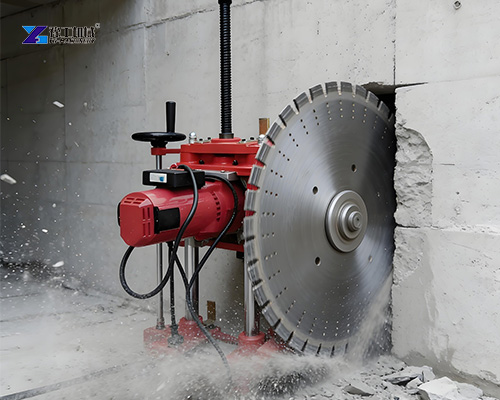
A wall saw machine runs on a track bolted directly to the wall or floor. The saw head carries a circular diamond blade that climbs or descends along that rail.
Key specs that matter
| Parameter | YG600 | YG700 |
| Power | 25 kW | 30 kW |
| Cooling | Air / water | Air / water |
| Rated Voltage | 380 V, 50 Hz | 380–420 V, 50–60 Hz |
| Pressure Stages | 3 | 3 |
| Maximum Operating Pressure | 200 bar / 20 MPa | 210 bar / 21 MPa |
| Oil Flow | 30–80 L/min | 40–100 L/min |
| Pump Dimensions | 600 × 650 × 1050 mm | 500 × 520 × 1100 mm |
| Pump Weight | 220 kg | 140 kg |
| Blade Diameter | 800–1400 mm | 800–1600 mm |
| Maximum Cutting Depth | 620 mm | 730 mm |
| Saw Maximum Pressure | 180 bar / 18 MPa | 200 bar / 20 MPa |
| Saw Maximum Oil Flow | 100 L/min | 100 L/min |
| Gearing | Gear | Gear |
| Saw Speeds | 450 / 950 / 1300 rpm | 450 / 850 / 1200 rpm |
| Saw Dimensions | 400 × 420 × 400 mm | 400 × 420 × 400 mm |
| Saw Weight | 38 kg | 39 kg |
Where it wins:
- Door and window openings in reinforced concrete walls
- Slab cutting where you need fast, repeatable straight runs
- Bridge deck joint removal with precision angle cuts
Request Wall Saw Machine Pricing


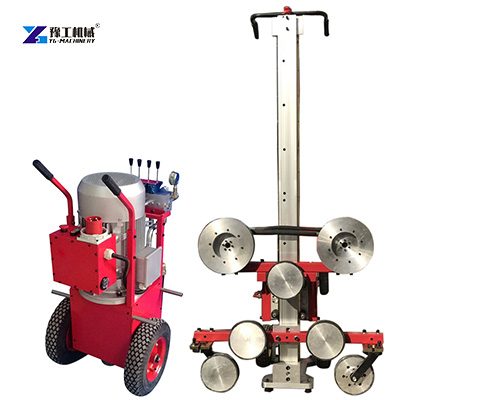
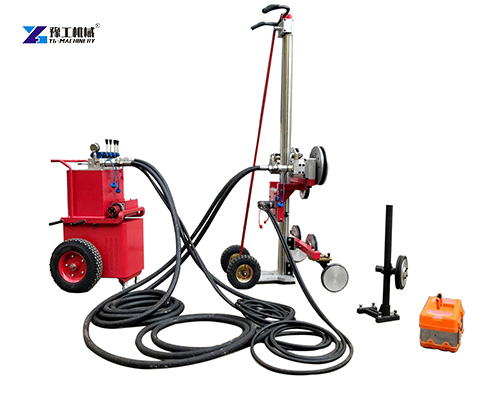
What Is a Concrete Wire Saw?
A concrete wire saw doesn’t use a blade. It uses a diamond-bead cable threaded through pre-drilled holes, guided by pulleys, and pulled at controlled tension.
Key specs that matter
| Wire Saw Wheel Parameters | Hydraulic Pump Parameters | ||
| Wire Drive Mode | hydraulic | Motor Power | 22/25kw |
| Motor Type | HM-80, 2 Cylinders | Voltage | 220V/380V, 50Hz |
| Minimum Input Power | 25HP/33HP | Hydraulic Pump Type | Gear Pump |
| Output Shaft Speed | 350/940/1300r/min | Main Drive Motor | 40-100L/min |
| Maximum Wire Length | 20m | Working Pressure | 15-20Mpa |
| Feeding Method | Fully hydraulic | Oil Tank Capacity | 17L |
| Wire Saw Wheel Weight | 64kg | Weight | 160kg |
| Motor Weight | 14kg | Size | 700*700*1200mm |
| Size | 1700*700*800mm |
Key capabilities:
- No depth limit—the wire is as long as the cut requires
- Cuts any shape, including curves and corners
- Works in confined spaces: mechanical rooms, below-grade vaults, underwater
- Remote operation keeps crews away from the cut zone
- Consistent cutting speed regardless of depth
Request Concrete Wire Saw Pricing
Wall Saw Cutter vs Concrete Wire Saw: Key Differences
The simplest way to understand the difference is to look at the actual job requirements.
| Factor | Wall Saw Cutter | Concrete Wire Saw |
| Cutting method | Diamond blade | Diamond wire |
| Ideal cut | Straight cuts | Straight, curved, or irregular cuts |
| Typical structures | Walls and slabs | Large or thick structures |
| Depth limitation | Related to blade diameter | Less restricted by blade radius |
| Installation | Guide rail required | Wire and pulley arrangement |
| Cutting accuracy | Very high for straight cuts | Depends on setup and structure |
| Typical applications | Openings and wall modification | Bridges, foundations, dams |
| Setup | Generally straightforward | More planning may be required |
This does not mean one machine is universally better than the other.
The right choice depends on concrete thickness, cutting shape, access conditions, reinforcement, and project volume.
Wall Sawing vs Wire Sawing: Which One Fits Your Project?
The best starting point is not the machine. Start with the concrete structure.
Choose a Wall Saw Machine If:
A wall saw machine is usually a suitable choice when:
- You need a straight cut.
- The working surface is relatively flat.
- A guide rail can be securely installed.
- You are creating rectangular openings.
- Cutting accuracy is important.
- The concrete thickness is within the machine’s practical blade capacity.
For building renovation, door openings, window openings, and utility penetrations, the controlled movement of a wall saw can make the cutting process easier to manage.
Choose a Concrete Wire Saw If:
Consider a concrete wire saw when:
- The concrete is extremely thick.
- The structure is unusually large.
- The cutting path is curved or irregular.
- Blade access is restricted.
- A circular blade cannot reach the required depth.
- You need to separate a large concrete section.
For example, imagine a contractor needs to create a 2.0 × 2.2 m opening through a 400 mm reinforced concrete wall. If there is enough flat space for rail installation, a wall saw machine can be a practical solution.
Now consider a thick bridge pier or large foundation block. The geometry and thickness may make a wire saw more appropriate.
The key is to match the cutting method to the structure, rather than choosing equipment based only on its purchase price.

FAQ about Wire Sawing & Wall Sawing: Which Cut Fits?
Q: Can a wall saw cut through heavily reinforced concrete?
Yes. Modern diamond blades handle rebar without issue. The limitation isn’t the steel—it’s depth and reinforcement density. If the section is extremely thick or densely packed, wire saw takes over.
Q: Can wire sawing be used in tight or confined spaces?
Absolutely. The wire threads through a small drilled opening and needs no rail. Crews use it in mechanical rooms, below-grade structures, and low-clearance plants where a wall saw’s track won’t fit.
Q: Which method is faster?
For straight cuts under 730mm: wall saw wins—15–30 minute setup and aggressive blade cutting. For deep or complex geometry: wire saw, because it can reach where the blade can’t and maintains consistent speed.
Q: Does wire sawing work underwater?
Yes. Diamond wire sawing is a standard method for submerged concrete cutting where wall saws can’t operate safely or effectively.
Q: What’s the typical cost difference?
Wire sawing runs 2–4× the cost per linear meter of wall sawing. That premium buys access and depth capability, not necessarily a “better” cut.