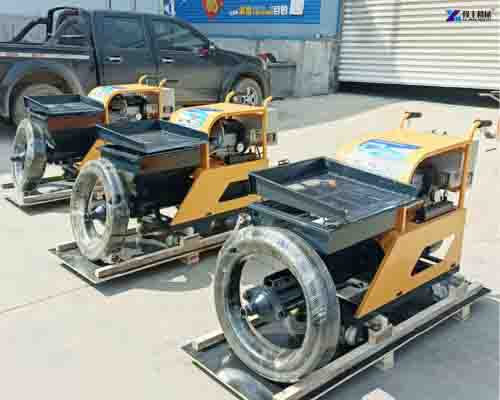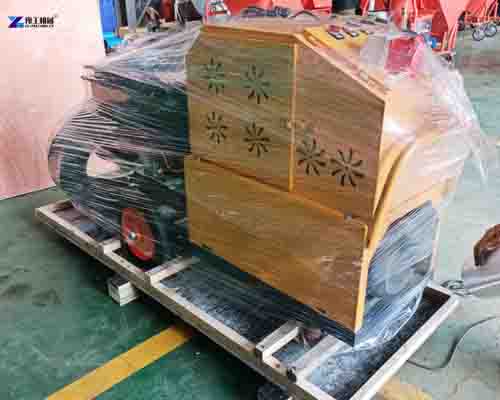
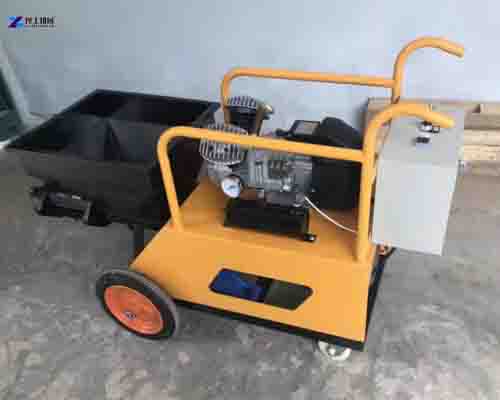
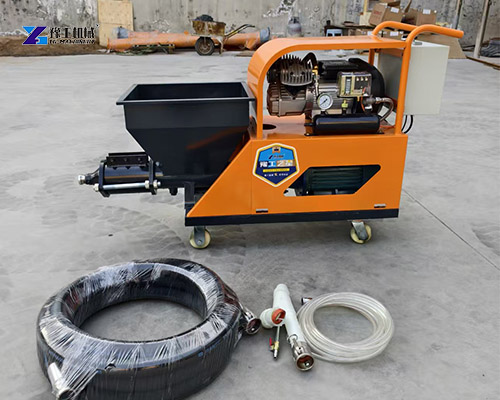
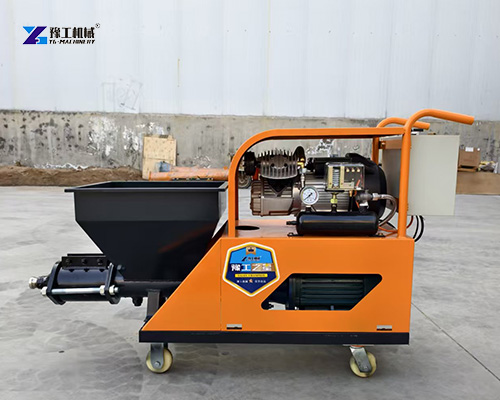
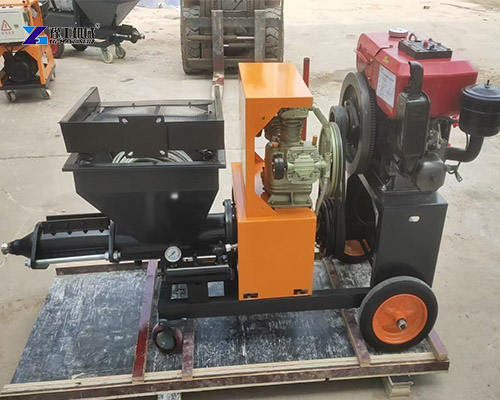
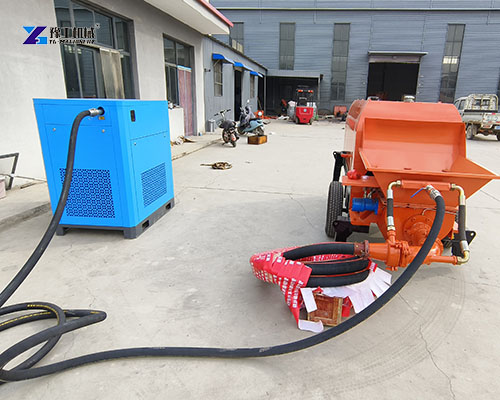
A mortar spraying machine is a practical solution for applying cement mortar, plaster, and render to walls and other surfaces. It is commonly used in residential, commercial, and renovation projects. Compared with manual plastering, it can reduce repetitive labor, improve application consistency, and simplify material delivery. YG offers several models for different material sizes, output requirements, and site conditions. If you want to improve plastering efficiency, choosing the right machine is a good place to start. 【WhatsApp/WeChat/Skype/Phone】+86 159 3715 2330
YG Mortar Spraying Machine Parameters-OEM Support
| Model | YG-311 | YG-318 | YG-711 |
| Capacity | 3m³/h | 3-5m³/h | 4-6m³/h |
| Pressure | 3 Mpa | 3 Mpa | 3 Mpa |
| Material Ratio | 0.7-1:1:3 (Water, Ash, Sand) | 0.7-1:1:3 (Water, Ash, Sand) | 0.7-1:1:3 (Water, Ash, Sand) |
| Voltage | 220V/380V 50Hz | 380V three-phase 50Hz | 380V three-phase 50Hz |
| Main Motor Power | 4kw | 7.5kw | 7.5kw |
| Particle Size | Below 4mm | Below 8mm | Below 8mm |
| Convey Distance | Horizontal 30m | Horizontal 50m | Horizontal 50m |
| Vertical 20m | Vertical 30m | Vertical 30m | |
| Volume | 60L | 80L | 100L |
| Air Consumption | 0.3m³/min | 0.3m³/min | 0.3m³/min |
| Weight | 200kg | 320kg | 340kg |
Manual Plastering vs Mortar Spraying Machine
Manual plastering requires workers to carry, apply, and level mortar by hand. It is flexible and works well for small repair jobs.
For large wall areas, however, the process can be labor-intensive. Workers also spend considerable time moving mortar from the mixing area to the working area.
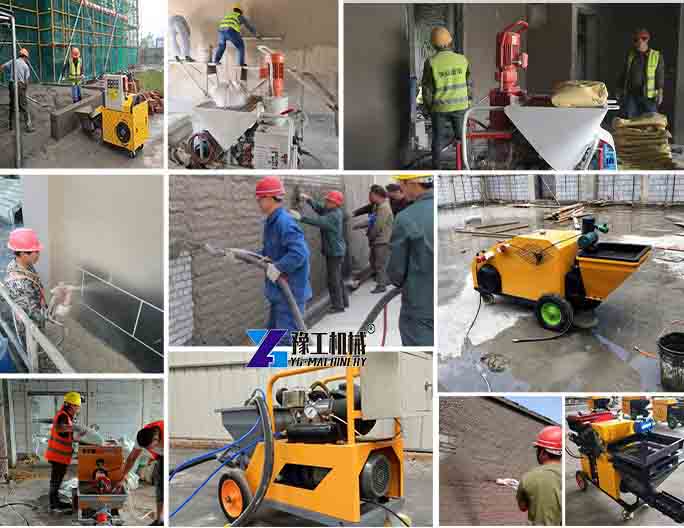
A Mortar Spraying Machine changes this workflow. Mortar is fed into the hopper, pumped through the hose, and sprayed onto the wall.
The main advantage is continuous material delivery. The operator can focus on controlling the spray gun instead of repeatedly carrying mortar.
Research comparing plastering methods has also found significantly higher application productivity with mechanical spraying under tested conditions, although actual results depend on material, workers, and site conditions.
Concrete Spraying Equipment for Better Productivity
When choosing concrete spraying equipment or related mortar equipment, capacity is important, but it should not be the only consideration.
Buyers should also check:
- Material particle size
- Pump pressure
- Horizontal and vertical conveying distance
- Motor power
- Voltage
- Air consumption
For example, a project with 300 m² of wall area may benefit from mechanical spraying because the machine reduces repeated material handling.
However, productivity is affected by the mortar formula, wall condition, operator skill, and site layout. Do not judge equipment only by its maximum capacity.
Cement Render Spray Equipment and Application Quality
Good cement render spray equipment starts with the correct material.
First, check the maximum particle size. Coarse material requires equipment that can handle the specified particle range.
Second, check the conveying distance. If the machine is on the ground and the spraying point is several floors above, vertical conveying capacity becomes important.
Third, consider the local power supply. A machine that does not match the site’s voltage or phase requirements can create unnecessary problems.
YG provides different models for different combinations of capacity, particle size, motor power, and conveying distance.
How to Choose the Right Mortar Spraying Machine
Before requesting a quotation, prepare these details:
- Required capacity
- Material particle size
- Mortar ratio
- Horizontal conveying distance
- Vertical conveying distance
- Available voltage
- Project type
- Expected working hours
For example, YG-311 supports material below 4 mm and a vertical conveying distance of 20 m. YG-318 and YG-711 support material below 8 mm and a vertical conveying distance of 30 m.
The best model depends on the complete working condition, not just output.
Manual Plastering or Automatic Spraying?
| Factor | Manual Plastering | Mortar Spraying Machine |
| Labor requirement | Higher | Lower |
| Application speed | Relatively slow | Faster |
| Material delivery | Manual | Pump-assisted |
| Application consistency | Worker-dependent | More consistent |
| Long-distance conveying | Difficult | More suitable |
| Initial investment | Lower | Higher |
| Large-area projects | Less efficient | More suitable |
Manual plastering remains useful for small or complicated areas. Mechanical spraying becomes more attractive when the project involves large, continuous wall areas.
How to Improve Spraying Results
Before operation, check the mortar ratio and particle size.
Keep material feeding stable and avoid unnecessary hose bends. During spraying, maintain a consistent gun distance and movement speed.
After work, clean the hose and pumping system promptly. Hardened mortar can cause blockages and increase downtime.
For overseas buyers, also confirm spare parts availability, power requirements, and technical support before placing an order.
Why Choose YG as Your Mortar Spraying Machine Manufacturer?
YG provides different machine configurations for contractors, distributors, and construction equipment buyers.
Instead of selecting a model only by price, send YG your material type, particle size, required output, voltage, and conveying distance.
YG can then help match the machine to your actual project requirements. 【WhatsApp/WeChat/Skype/Phone】+86 159 3715 2330
FAQ About Mortar Spraying Machine
1. What materials can a mortar spraying machine handle?
It depends on the machine and material formulation. Always confirm particle size and material ratio before ordering.
2. Which YG model should I choose?
Compare capacity, particle size, conveying distance, motor power, and voltage. YG-311 is the smaller model, while YG-318 and YG-711 provide higher capacity.
3. Why is particle size important?
The material must be within the machine’s specified particle-size range. YG-311 supports below 4 mm, while YG-318 and YG-711 support below 8 mm.
4. Can these machines be used for high-rise projects?
YG-311 has a listed vertical conveying distance of 20 m. YG-318 and YG-711 are listed at 30 m. Actual suitability depends on the project.
5. What information is needed for a quotation?
Provide the material, particle size, required capacity, voltage, conveying distance, and application. This allows YG to recommend a suitable model.
If you are planning to replace manual plastering with mechanical spraying, contact YG with your project details and get a suitable equipment recommendation.